How to Translate Video Subtitles Without Losing Meaning
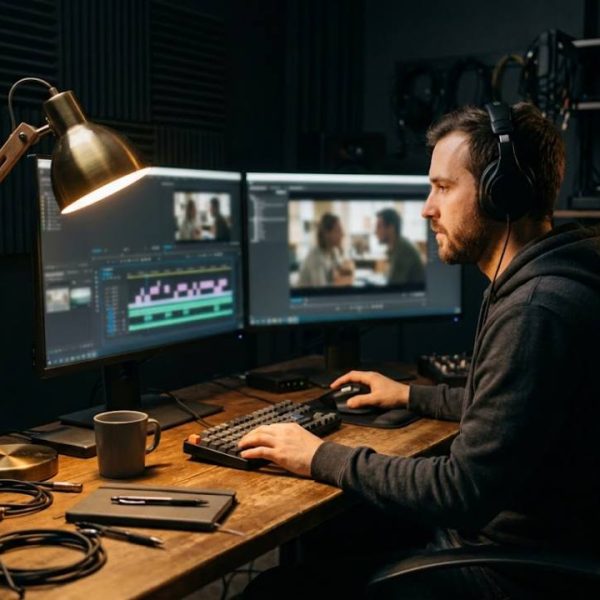
A subtitle has about two seconds to do its job. In that time it has to carry the meaning of what was said, match the rhythm of the speaker and stay short enough for a viewer to read while still watching the picture. Translating subtitles is therefore very different from translating a document. You are not only moving words between languages. You are compressing, timing and adapting them for the screen.
This guide walks through how professional subtitle translation works, where most projects go wrong and how creators, educators and businesses can get subtitles that feel natural in every language.
Start with a clean transcript
Every good subtitle project begins with an accurate transcript in the source language. Automatic speech recognition has improved a lot, but it still struggles with accents, overlapping voices, product names and technical terms. An error in the transcript becomes an error in every language that follows.
Before translation starts, someone should review the transcript against the video, correct names and numbers, and mark anything unclear. It also helps to note speaker changes, on-screen text that needs translating and any jokes or cultural references that may need a creative solution.
Understand the file formats
Most subtitle work happens in simple text formats. SRT is the most common: each subtitle has a number, a start and end time, and one or two lines of text. WebVTT is similar and widely used on the web. Some broadcasters and streaming platforms use more complex formats with styling and positioning.
The key point is that timing and text live together. Translators should never change timecodes accidentally, and they should keep line breaks sensible so the subtitle reads well on screen.
Respect reading speed and line length
Viewers read subtitles while also watching faces, gestures and action. Industry guidelines usually limit each line to around 37 to 42 characters and keep reading speed below roughly 17 characters per second for adults. Children's content needs slower speeds.
This is where translation becomes adaptation. French and German usually need more characters than English to say the same thing, while Chinese and Japanese often need fewer. A literal translation that runs too long will either flash past too quickly or force the viewer to choose between reading and watching. Good subtitle translators condense without losing the point.
- Remove filler words such as "you know" or "basically" unless they matter.
- Prefer short, common words over long formal ones.
- Split long sentences across two subtitles at natural pauses.
- Keep names, numbers and key terms exactly right, even when shortening.
Keep terminology consistent
Educational series, product tutorials and corporate training videos often repeat the same terms across dozens of episodes. If a software menu is called one thing in episode one and something else in episode six, learners get confused. Teams that subtitle at scale usually work in a cat tool that stores glossaries and previously approved translations, so each recurring phrase is handled the same way every time and nobody has to remember decisions made months ago.
Choosing the right translators for each language
Subtitle translation rewards native speakers who know the subject. A cooking channel, a medical training course and a gaming stream each have their own vocabulary and tone. For French-speaking audiences in Europe and Canada, many creators work with professional english to french translation services that understand both the language and the regional differences, such as vocabulary that sounds natural in Paris but odd in Montreal.
Eastern European and Central Asian audiences are another large market for video content. Accurate translation english to russian for subtitles needs to handle long grammatical endings within tight character limits, which takes practice and a good ear.
Accessibility is part of the job
Subtitles are not only for foreign-language viewers. Captions for deaf and hard-of-hearing audiences include sound descriptions such as [door slams] or [soft music] and identify speakers when they are off screen. The W3C Web Accessibility Initiative explains what good captions should include. When planning a multilingual project, decide early whether each language needs translation subtitles, full captions or both.
Quality assurance before publishing
Even an excellent translation can look wrong on screen. A final review should always happen with the video playing, not just in a text file.
- Check that every subtitle appears and disappears at the right moment.
- Look for subtitles covering on-screen text or faces.
- Confirm that special characters display correctly, especially for languages with accents or non-Latin scripts.
- Watch for jokes, idioms or references that no longer make sense.
- Test on mobile, where screens are small and line breaks matter more.
The best subtitles are the ones viewers forget they are reading. If people talk about the content instead of the subtitles, the translation has done its job.
Machine translation as a starting point
AI tools can now produce rough subtitle translations in seconds. For internal videos or quick drafts, that may be enough. For public content, especially marketing, education or anything with legal or medical information, machine output should be treated as a first draft. A human editor fixes errors, adjusts tone and makes sure the subtitles fit reading speed rules.
A sensible workflow combines both: machine translation for speed, then a professional post-edit for quality and a final check in the video player.
Plan for many languages from the start
If you know a video will be subtitled in several languages, plan for it while scripting and filming. Avoid burning text into the picture, leave space at the bottom of the frame and keep a clean version without on-screen captions. Write scripts in clear, simple sentences. These small decisions make translation faster, cheaper and better in every language.
Subtitles that travel well
Translating subtitles well is a craft that blends language skill, timing and empathy for the viewer. Start with an accurate transcript, respect reading speed, keep terminology consistent and always review on screen. Done properly, subtitles turn a single video into content that speaks to the whole world.
Accurate subtitles require more than literal word conversion. Skilled linguists balance timing, reading speed, and cultural nuance. For best results, choose translation services..